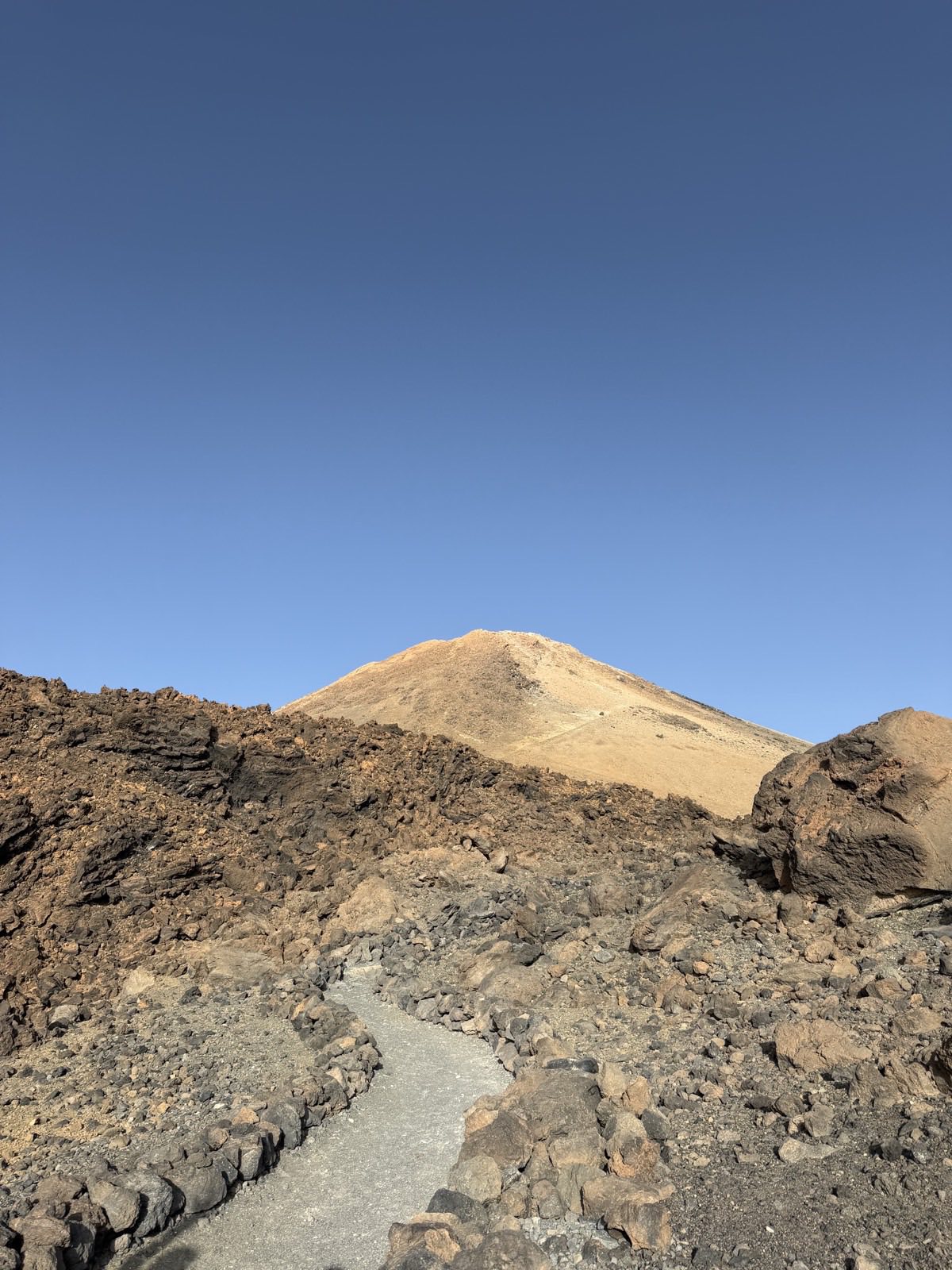
Teide Summit Permit: How to Book It in 2026 (and What to Do If It's Sold Out)
The last 160-odd metres of Spain are behind a locked gate. Anyone can drive into Teide National Park for free, and anyone with a cable car ticket can ride to La Rambleta at 3,555 m — but the final stretch to the 3,715 m crater, the Telesforo Bravo trail (no. 10), needs a named, pre-booked permit, and in 2026 both the booking system and the price changed. This guide covers exactly how it works now, because half of what’s written online still describes the old system.
What the summit permit actually is
Pico del Teide’s summit cone is closed to free access. From La Rambleta — the plateau where the cable car tops out and where trail 7 from Montaña Blanca arrives — a single zig-zag path, trail no. 10 “Telesforo Bravo”, climbs the last 160 vertical metres to the crater rim. It takes 30–45 minutes up at that altitude, and there’s a staffed checkpoint at the bottom of it.
The permit is personal (it carries your name and passport or ID number), valid only for one specific date and time window, and non-transferable. Without it, your day on Teide ends at La Rambleta. With it, you stand on the highest point in Spain, looking down into a crater that still breathes warm sulphur through cracked yellow rock.
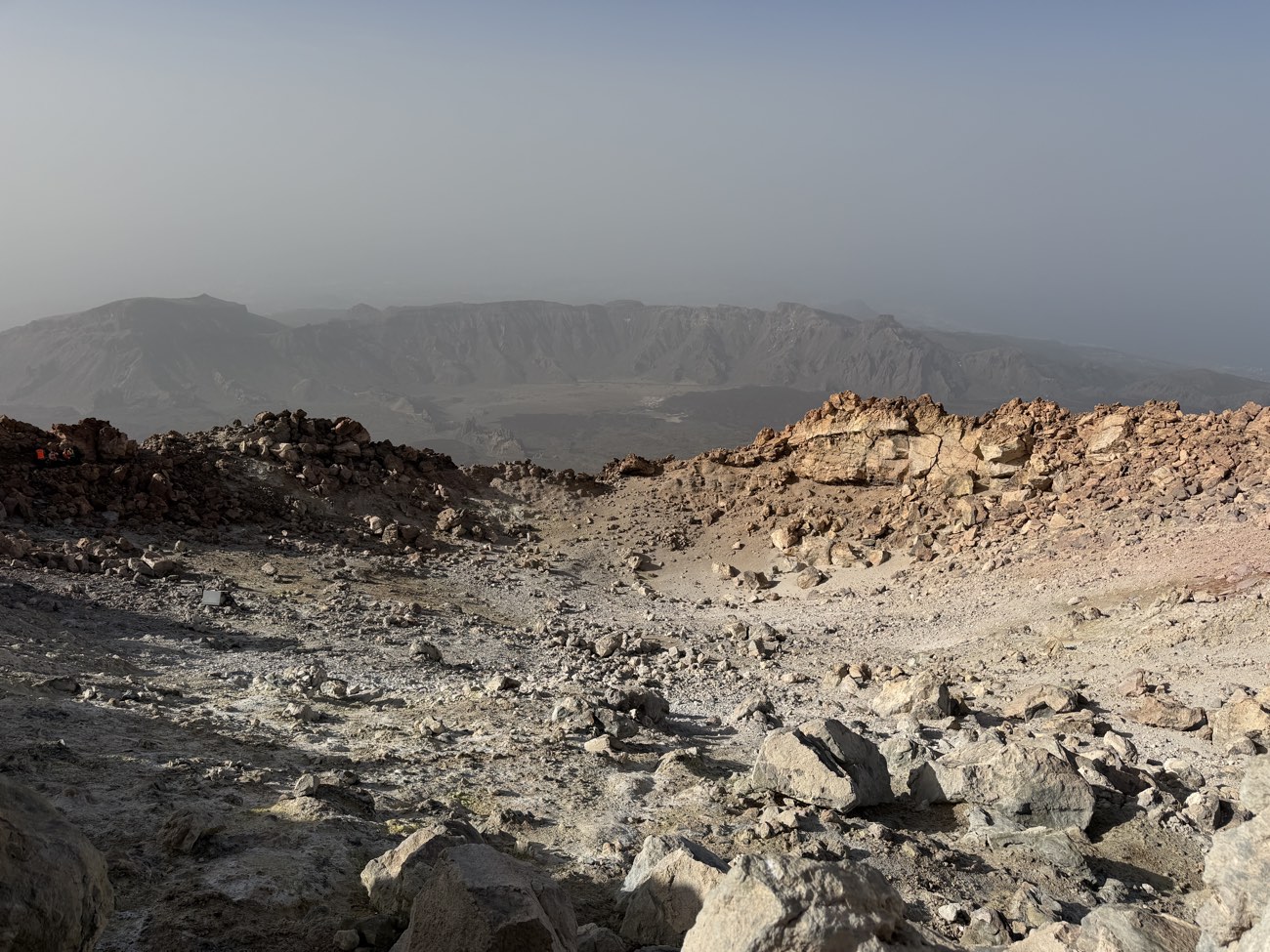
The reward: sulphur-bleached rock on the crater rim at 3,715 m. The smell arrives before the view does.
Everything else in the park — the Roques de García loop (trail 3), Montaña Blanca as far as La Rambleta, the miradors along the TF-21 — needs no summit permit, though some trails now have their own separate reservations (more on that below).
Why the cap exists
Teide National Park has been a UNESCO World Heritage Site since 2007 and is, on recent counts, the most visited national park in Spain, with well over four million visitors a year. The summit cone itself is tiny, geologically fragile and actively degassing: the fumaroles around the crater have stained the rock orange and yellow, and unrestricted foot traffic was eroding the cone badly by the time restrictions came in.
So the park caps daily numbers on trail 10 — reported at around 200 people a day spread across the time windows, though the booking site doesn’t publish a headline figure — and holds everyone to a maximum of two hours in the summit zone. It’s a rationed experience, and in July and August the ration runs out fast.
The 2026 shake-up: Tenerife ON and the new fees
Two changes matter if you last looked into this before 2025:
1. The booking platform moved. The summit permit used to live on the Spanish national parks portal, reservasparquesnacionales.es. It doesn’t any more — that site now tells you outright that reservations “must be made and managed directly through Tenerife ON”. Everything is booked at tenerifeon.es, the island government’s activity-booking platform. If a blog sends you to the old portal, it’s out of date.
2. It’s no longer free for most visitors. From 19 January 2026, Tenerife introduced an eco-fee for the busiest Teide trails, including trail 10. The charging applies to the daytime windows (09:00–17:00):
| Who you are | Trail 10 fee (daytime) |
|---|---|
| Tenerife residents | Free |
| Children under 14 | Free |
| Residents of other Canary Islands | €6 |
| Everyone else, with an authorised guide | €10 |
| Everyone else, unguided | €15 |
The Montaña Blanca ascent route (trail 7) — the classic on-foot climb, roughly 1,350 m of ascent from the TF-21 at km 40.2 — also now requires its own permit on Tenerife ON, introduced in November 2024, with a smaller fee (free for Tenerife residents, up to about €10 for non-resident visitors at weekends). If you’re hiking Teide from the bottom, you need both reservations, timed to match.
As of mid-2026 the dawn and dusk windows sat outside the charging hours, but this is exactly the sort of detail that keeps moving — treat the booking screen on Tenerife ON as the truth on the day you book.
How to book, step by step
- Go to tenerifeon.es and create an account (you’ll need one to manage or cancel anything later).
- Navigate to the Teide National Park section and select the Pico del Teide access permit (PNT 10, Telesforo Bravo).
- Pick your date and time window from the calendar. Grey means gone.
- Enter the full name and passport or national ID number of every person in your group, exactly as they appear on the documents. The permit is checked against these at the gate — a typo can sink you.
- Pay the fee (card) if your category and window attract one, and download the confirmation with its QR code. Keep it on your phone and, ideally, printed.
- If you’re walking up rather than taking the cable car, repeat the process for the Montaña Blanca (PNT 7) permit, choosing the access period that matches your start time.
Booking a slot on Tenerife ON does not book the cable car — that’s a separate ticket from the operator, Volcano Teide. Match the times yourself: for a 13:00–15:00 summit window, you want to be riding up by midday.
The time windows, explained
| Window | Hours | Cable car running? | Best for |
|---|---|---|---|
| Morning | 09:00–11:00 | Yes | Clearest air, coolest climb |
| Late morning | 11:00–13:00 | Yes | The easy logistics pick |
| Early afternoon | 13:00–15:00 | Yes | Latecomers; haze builds |
| Afternoon | 15:00–17:00 | Yes — last slot with a ride down | Cutting it fine |
| Dusk | 18:00–22:00 | No — you descend on foot in the dark | Experienced hikers, sunset |
| Dawn | 06:00–09:00 | No — you climb overnight or sleep at Altavista | Sunrise above the clouds |
Whichever window you hold, the two-hour limit in the summit zone applies. The dawn and dusk windows are genuine mountain undertakings: no cable car, sub-zero wind chill even in summer, and a long walk on volcanic scree by head torch. They’re also the best thing the mountain offers.
How far ahead does it sell out?
Here’s the part that catches people out: you can’t book with your flights six months ahead. Under the current system, new dates are released on a rolling window — fresh slots open every Monday at 07:00 Canary time, keeping roughly the next 56 days bookable (the window was doubled from 28 days in March 2026). (Handy for British visitors: the Canaries keep the same clock as the UK year-round, so that’s 07:00 UK time too, not mainland-Spain time.)
In practice, in high summer:
- Daytime slots for popular dates thin out within hours of the Monday release and are gone within a day or two.
- Dawn slots are the scarcest on the mountain and effectively vanish at release.
- Shoulder-season weekdays (see when to visit) are far more forgiving — you can sometimes book a Tuesday in November a week out.
The strategy is boring but effective: work out which Monday your target date unlocks, set an alarm for 06:55, and have your account, passport numbers and card details ready. Cancellations do trickle back into the system, so if you miss out, re-check daily rather than giving up.
What happens at the gate
The trail 10 checkpoint sits a short walk above the cable car’s upper station, and the wardens take it seriously. They scan the QR code and check the ID of the person named on the booking — and they can ask every member of the group for identification. No document, no summit: the permit is nominal precisely so it can’t be resold or passed around.
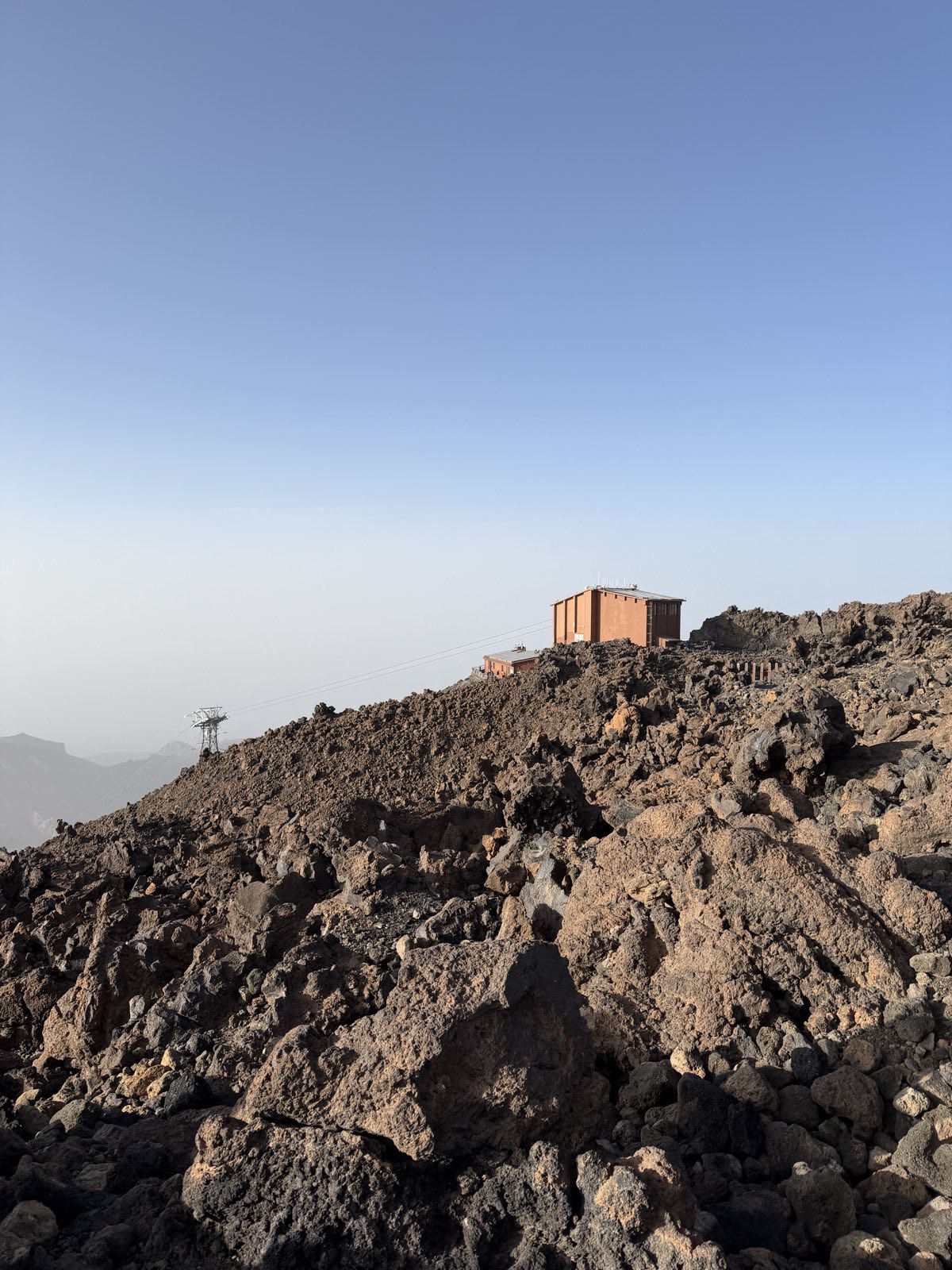
The hut on the upper slope near La Rambleta. The trail 10 gate is minutes away — have your passport out before you reach it.
When I climbed in July 2026, the warden was checking passports against the list by torchlight before 07:00 for the dawn window, and turned away a couple whose booking was in a friend’s name. Bring the actual document you booked with — a phone photo of it is at the warden’s discretion.
Time-keeping matters too. Arrive within your window; there’s no grace period at either end, and afternoon permit holders who miss the last cable car down face a two-and-a-half-hour descent to the road on foot.
The sunrise route: Altavista is back
For years the romantic route to the top — overnight at the Refugio de Altavista at 3,260 m, then up trail 10 in the dark to catch sunrise from the crater — was closed off. The refuge shut in 2020 and stayed shut for more than five years.
That changed on 20 July 2026, when Altavista reopened after a full renovation, now managed by the cable car operator. The rebuilt refuge has 49 bunk beds across three dormitories, solar power, toilets but no showers, a kitchen with microwave and fridge, and a vending machine that takes cards. You bring a sleeping bag — no linen is provided. Standard rate at reopening was €71 per night (€29 for Tenerife residents, €56.80 for federated mountaineers), booked at refugioaltavista.com.
The crucial detail: a refuge booking includes the trail permits — both Montaña Blanca (trail 7, for the walk up between 15:00 and midnight — check-in at the refuge by 22:00) and Telesforo Bravo (trail 10, for a dawn ascent between 06:00 and 09:00 the next morning). The old “loophole” — refuge guests summiting before the 09:00 checks without a separate permit — has effectively been formalised into the booking. If dawn on the crater is the goal, Altavista is once again the sanest way to get it, and in its first season the beds are in heavy demand.
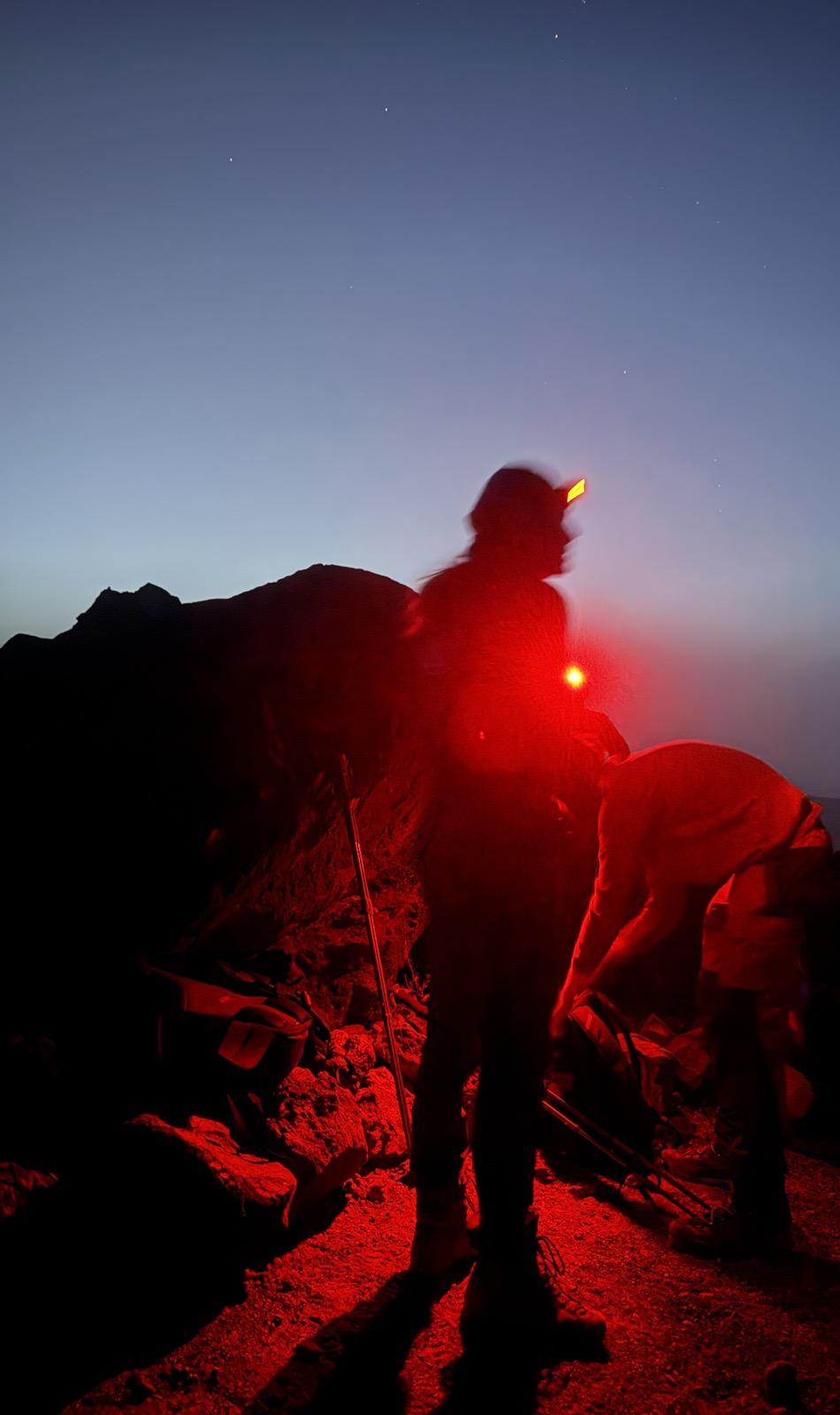
Head torches on the upper mountain around 5 a.m. The final zig-zags to the crater are steep, loose and cold — and utterly silent.
The alternative, which is what I did that July night, is the straight-through night climb: start from the Montaña Blanca trailhead in the small hours holding a trail 7 permit for the overnight period plus a trail 10 dawn permit, and walk through the night to reach the rim as the sky turns orange. It’s around 1,350 m of relentless ascent, the last hour of it above 3,400 m, and standing on the crater as the sun breaks the horizon and Teide’s shadow stretches as a perfect triangle across the sea of clouds is the single best thing I’ve done in the Canaries. If that’s the plan, read the sunrise and sunset guide first — the logistics (and the cold) deserve their own page.
If the weather closes the trail
The park closes trails 7 and 10 for storms, ice and high wind — it happened for days at a stretch in February 2026 — and the cable car makes its own go/no-go decision, typically on the morning itself. Your permit does not automatically transfer to another day: officially you must contact Tenerife ON if a closure kills your slot, and you shouldn’t count on either a refund or a rebooked date, especially in a busy week.
The practical defences: build a spare day into your Tenerife itinerary if the summit genuinely matters to you, favour morning windows (afternoon closures are more common as weather builds), and check the park’s status and the cable car’s service page the evening before and again at breakfast. If you’re driving up, remember the TF-21 itself can be closed by ice in winter — the getting to Teide guide covers the roads and the once-a-day Titsa buses.
Sold out? Your two real workarounds
No permit is not the end of the story. Two legitimate routes remain — and one consolation prize.
1. A guided summit tour with the permit included. Licensed operators hold their own permit allocations, which is why tours can confirm summit access when the public calendar shows nothing for weeks. The official operator sells guided ascents with the permit bundled (they recommend booking at least a week or so ahead), and equivalent cable-car-plus-summit-hike tours are bookable through GetYourGuide. This is the standard fix for people who discover the permit system three days before they fly. Browse the tours worth booking for the current options — a guided dawn or daytime summit typically costs more than DIY, but it removes the permit lottery, the ID admin and the route-finding in one go.
2. The refuge route. If Altavista has a bed on your dates, the permits come with it, as above. Check the refuge site even when Tenerife ON shows trail 10 fully booked — they’re separate allocations.
The consolation prize: ride the cable car up anyway. From La Rambleta, two short permit-free trails lead to genuine viewpoints — no. 11 to the Mirador de La Fortaleza, facing north over the sea of clouds towards La Orotava, and no. 12 to the Mirador de Pico Viejo, overlooking the 800 m-wide crater of Teide’s neighbour and, on clear days, La Gomera, La Palma and El Hierro. You lose the last 160 m of altitude, not the view. Many people who “climbed Teide” actually did exactly this.
Your booking timeline
| How far out are you? | Your realistic options |
|---|---|
| More than two months | You can’t book trail 10 yet — the calendar only opens ~56 days out. Diarise the right Monday (07:00 Canary/UK time), decide your window now, and book flexible cable car tickets. |
| 1–2 months | Prime time. Hit the Monday release for your date; book trail 7 too if walking up; check Altavista for beds if you want sunrise. |
| 1–2 weeks | Public slots likely gone for daytime. Check daily for cancellations, then pivot: guided summit tour with permit included, or a refuge bed if any remain. |
| This week | Guided tours are your only realistic summit route — operators hold allocations the public calendar doesn’t show. Otherwise: cable car + trails 11/12, which is 90% of the scenery with 0% of the paperwork. |
Frequently asked questions
Is the Teide summit permit still free?
Not for most visitors. Since 19 January 2026, daytime access (09:00–17:00) on the Telesforo Bravo trail costs €15 for non-resident adults (€10 if you’re with an authorised guide), €6 for residents of other Canary Islands, and remains free for Tenerife residents and children under 14. When I booked in mid-2026 the dawn and dusk windows sat outside the charging hours, but check the live prices on Tenerife ON — the fee system is new and still settling.
How far in advance can I actually book the permit?
About eight weeks, and no more. Tenerife ON releases new dates on a rolling window, with fresh slots appearing every Monday at 07:00 Canary time (the same as UK time) so that roughly the next 56 days stay bookable — the window was extended from 28 days in March 2026. In July and August, daytime slots for weekends go within hours and dawn slots go almost instantly, so set an alarm for the Monday your date unlocks rather than assuming you can book with your flights months ahead.
Can I climb Teide without a summit permit?
You can climb almost all of it. The park itself is free to enter, and you can walk Montaña Blanca to La Rambleta at 3,555 m (with the separate trail 7 reservation) or ride the cable car there. Only the final 160 m on trail 10 is permit-controlled, with a staffed checkpoint. Slipping past it risks a fine plus any rescue costs — and wardens do check IDs against the permit list.
Does the cable car ticket include the crater?
No. The cable car and the summit permit are two entirely separate bookings — the ride with Volcano Teide gets you to La Rambleta at 3,555 m, and the free-roaming ends there. Plenty of visitors buy the cable car ticket assuming it includes the top and only discover the checkpoint on the day. If you want both, book the Tenerife ON permit first (it’s the scarcer of the two), then match your cable car time to your permit window.
What happens if bad weather closes the trail on my day?
The permit dies with the day. Closures for wind, ice or storms are decided by the park — and the cable car separately decides each morning whether it runs. There’s no automatic transfer to another date; you’re told to contact Tenerife ON, and neither a refund nor a rebooking is guaranteed. If the summit is the point of your trip, keep a spare day in the itinerary and prefer morning windows, which dodge the afternoon weather more often.
Does staying at Altavista Refuge include the summit permit?
Yes — this is the quiet advantage of the refuge, which reopened on 20 July 2026 after more than five years closed. A bed (from €71 a night, sleeping bag required) comes bundled with the Montaña Blanca permit for the walk up and a Telesforo Bravo permit for a dawn ascent between 06:00 and 09:00 the next morning. It’s booked at refugioaltavista.com, on a separate allocation from the public Tenerife ON calendar.
Do children need a permit too?
Yes — every person on the trail needs to be named on a booking with their ID or passport number, whatever their age. Children under 14 pay nothing, but they still occupy a slot, so include them when you book. Note the refuge sets a minimum age of 14 for overnight stays, and the final climb is a genuine 3,700 m ascent — cold, steep and thin-aired — so think hard before bringing young children beyond La Rambleta.